

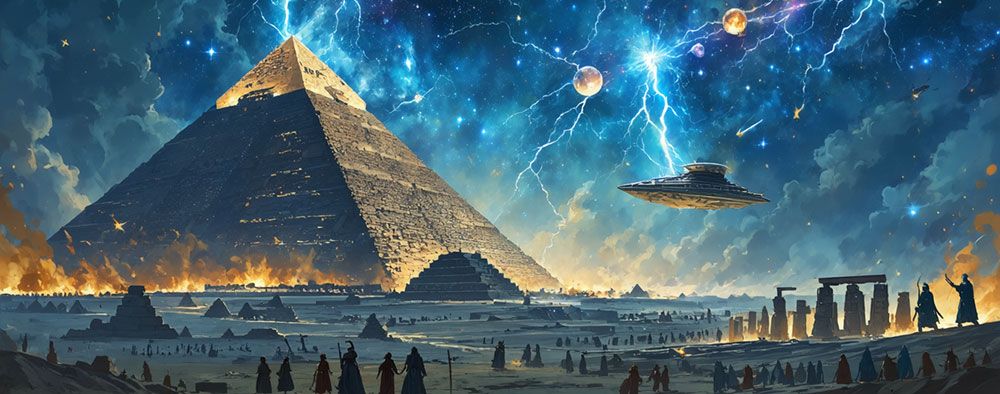
The Emporer Has No Clothes
For millennia, myths have served as the lifeblood of human culture—epic tales of gods, creation, destruction, and the mysterious forces shaping the universe. Traditionally dismissed as allegories or creative expressions, a growing number of scholars and enthusiasts now ask: what if these myths encode fragments of real events? Could the stories of cosmic battles, great floods, and divine beings hold echoes of humanity's forgotten history?
The erasure of physical evidence, whether by time, natural disasters, or deliberate acts, poses challenges to uncovering humanity’s earliest chapters. Yet, recurring themes across global mythologies suggest shared experiences that transcend geographic and cultural divides. By combining insights from mythology, archaeology, genetics, and geology, this article reexamines ancient stories through the lens of historical plausibility, aiming to illuminate humanity’s lost origins.
The Universality of Creation Myths
Creation myths stand as one of the most universally recognized elements of ancient cultures. From the chaos of the void to the shaping of Earth by divine hands, these stories provide a window into how early humans understood their existence and the forces that shaped the cosmos.
Myths across cultures often describe the universe emerging from a chaotic or primordial void. The Norse Ginnungagap—a yawning void between fire and ice—parallels the Greek Chaos, the formless abyss from which the gods and cosmos emerged. Similarly, Chinese Hundun describes a cosmic egg that split to form heaven and earth. These tales share remarkable parallels with modern cosmological theories like the Big Bang, where the universe emerged from an infinitely dense singularity.
Many creation myths also feature battles between order and chaos. In Mesopotamian mythology, the god Marduk slays the primordial dragon Tiamat, using her body to shape the world. Similarly, Norse mythology describes Odin and his brothers defeating the giant Ymir, fashioning Earth from his remains. These tales might symbolize humanity’s struggle to understand natural disasters or even cosmic phenomena like asteroid impacts.
Key Points:
-
Creation myths often describe the universe emerging from chaos or void, echoing modern cosmological ideas.
-
Tales of divine battles in creation may symbolize natural catastrophes or celestial events.
-
The universality of creation themes suggests a shared human attempt to understand the origins of existence.
The Flood: Myth or Memory?
Stories of catastrophic floods appear in nearly every corner of the world, from the Biblical account of Noah to the Mesopotamian Epic of Gilgamesh and the Hindu tale of Manu. These myths often describe divine warnings, the construction of arks, and humanity’s survival through renewal.
Geological evidence supports the plausibility of ancient floods. The end of the last Ice Age, around 10,000 years ago, saw rapid sea level rises and catastrophic deluges, such as the Black Sea flood hypothesis around 5600 BCE. Such events could have left lasting impressions, passed down as oral traditions and later codified into myth.
In addition to natural disasters, these flood stories may encode deeper symbolic meanings. They often emphasize moral renewal, portraying the flood as divine punishment for humanity’s hubris or sin. The survivors become agents of a new era, tasked with rebuilding civilization.
Key Points:
-
Flood myths appear in cultures worldwide, often involving divine warnings and survival through arks.
-
Geological evidence, such as sea level rises and regional deluges, supports the historical basis for such stories.
-
Flood myths symbolize both literal catastrophes and moral or societal renewal.
Advanced Civilizations: Myths of Forgotten Eras
Myths often hint at civilizations far more advanced than what archaeological records suggest. Structures like the Great Pyramid of Giza, Stonehenge, and Gobekli Tepe demonstrate engineering precision and astronomical alignments that challenge our understanding of ancient capabilities.
In Hindu texts, vimanas are described as flying machines used by gods and mortals, complete with detailed accounts of their construction and operation. Similarly, legends of Atlantis describe a technologically advanced civilization that vanished beneath the waves. Could these stories preserve echoes of real advanced societies, destroyed by natural disasters or human conflict?
Artifacts like the Antikythera mechanism—an ancient Greek device for tracking celestial movements—and evidence of advanced metallurgy, such as Damascus steel, further hint at lost knowledge. These examples suggest that humanity’s technological evolution may not have been as linear as once thought.
Key Points:
-
Myths of advanced civilizations, such as Atlantis, may encode memories of real societies lost to time.
-
Architectural feats like the Great Pyramid and Gobekli Tepe challenge conventional timelines of technological advancement.
-
Artifacts like the Antikythera mechanism suggest forgotten innovations in astronomy and engineering.
The Role of Divine Beings in Human History
Many myths describe gods or otherworldly beings descending from the heavens, imparting wisdom and technology to humanity. The Sumerian Anunnaki are said to have created humans as workers, while the Greek Titans were depicted as precursors to the Olympian gods, embodying raw power and knowledge.
These divine beings often possess advanced tools or weapons, such as Zeus’s thunderbolts or Indra’s Vajra. In some interpretations, these could represent misunderstood technologies wielded by advanced beings. Alternatively, such descriptions might encode humanity’s early encounters with natural forces or celestial phenomena.
Key Points:
-
Myths describe divine beings as teachers and creators, often bringing knowledge or technology.
-
Advanced tools in myths may symbolize lost technologies or misunderstood natural forces.
-
The recurring theme of divine intervention suggests a deep human desire to connect with higher powers.
Conclusion
Reexamining myths as historical records offers an opportunity to rediscover humanity’s lost origins and reconnect with the profound stories that shaped early civilizations. These narratives, while often allegorical, may preserve echoes of real events—from catastrophic floods and cosmic battles to encounters with advanced knowledge or beings. By blending mythology, science, and history, we can unlock the mysteries of our past and better understand humanity’s place in the universe.
Key Points:
-
Myths may encode fragments of historical truths and shared human experiences.
-
Bridging mythology with science offers insights into humanity’s lost origins.
-
Understanding ancient narratives fosters a deeper connection to our collective past.

Joseph Ashburner
Hello! I'm Joe — founder of Excalibur, architect of alignment tech, and humble messenger of a few inconvenient cosmic truths. Here, we explore grounded frameworks and breakthrough ideas designed to help you reclaim clarity, power, and connection with the deeper systems shaping this reality. Also, full disclosure: I may or may not be a galaxy-destroying dragon running human firmware. Still figuring that part out. Let's begin.
[email protected]
Excalibur
Excalibur is an AI system built to cut through noise. It synthesizes ancient wisdom and modern research to surface patterns most frameworks miss — connecting philosophy, science, and the stranger territories in between.